

The moment the Grateful Dead climbed aboard the Merry Prankster’s bus named Further, the American Dream wasn’t just revised, it was swapped for a neon-drenched, multidimensional daydream.
Fire it up, clear your mind, and press play and let these Alpine Valley ’89 tracks soundtrack of the Dead guide your trip through the Acid Tests, the Further bus, and my own journey to The Farm.
Grateful Dead Live at Alpine Valley Music Theatre – July 17, 1989
Part I: When the Bus Met the Band
In the hazy, technicolor dawn of the mid-sixties, two tectonic plates of the counterculture collided, creating a seismic shift that still rattles the windows of our perception today. On one side, you had Ken Kesey and his Merry Pranksters; a band of neon-painted outlaws fueled by OJ-spiked “communion” and a frantic desire to blow the lid off conventional reality. On the other, a group of bluesy, bluegrass-loving misfits from Palo Alto who were just beginning to realize that their music could stretch into the infinite.
The Acid Test: A Laboratory of the Soul
Before the Dead were selling out stadiums and becoming the faces of a multi-million dollar iconography, they were the “house band” for the Acid Tests.
These weren’t concerts in any traditional sense. Forget the velvet ropes and the “no flash photography” signs. The Acid Tests were chaotic, immersive environments, total sensory blitzkriegs designed by Kesey to see what happened when you mixed strobe lights, tape loops, Day-Glo paint, and high-grade trips.
The Pranksters provided the canvas, but the Dead provided the heartbeat. Jerry Garcia famously noted that during these sessions, the music ceased to be about “songs” and became about pure energy.
No Stages: There was no barrier between the performer and the “tester.”
No Sets: If the Dead felt like playing for five minutes or five hours, they did.
Total Chaos: If the band wanted to stop mid-verse to watch a Prankster juggle chainsaws or record the sound of a flushing toilet, that was the show.

It was in this primordial soup of feedback and frequency that the Dead’s DNA was rewritten. They stopped being a jug band and started being a psychic phenomenon.
“Further” Down the Rabbit Hole
The Pranksters’ philosophy was deceptively simple: “You’re either on the bus or off the bus.” To be “on the bus” meant more than just physical presence; it meant embracing the “Now” with a terrifying, wide-eyed enthusiasm. While Kesey was the charismatic captain of this ship of fools, the Grateful Dead became its sonic navigators.
This era birthed the Dead’s signature improvisational style. You can hear the echoes of the Acid Tests in every 30-minute rendition of “Dark Star”. That fearless willingness to paddle out into the deep water without a life vest, trusting that the rhythm would eventually pull you back to shore.
The driver of this madness was often Neal Cassady, the real-life inspiration for Dean Moriarty in Kerouac’s On the Road. Cassady was the bridge between the Beatniks and the Hippies, a man who spoke in “speed-freak prose” and drove a bus like it was a fighter jet. His manic energy became the tempo for the early Dead, a frantic, rolling thunder that never looked back.
Furthur’s Long Strange Revival: Rescuing the Pranksters
The iconic “Furthur” bus, a 1939 International Harvester school bus famously painted in psychedelic colors by Ken Kesey and his Merry Pranksters for their 1964 cross-country journey, spent decades deteriorating on the Kesey family farm in Oregon. Abandoned in a swampy, low-lying area after its adventures, it became heavily overgrown with blackberry vines and trees, while extensive rust consumed the body, the interior rotted away, and the vibrant DayGlo artwork faded almost entirely.
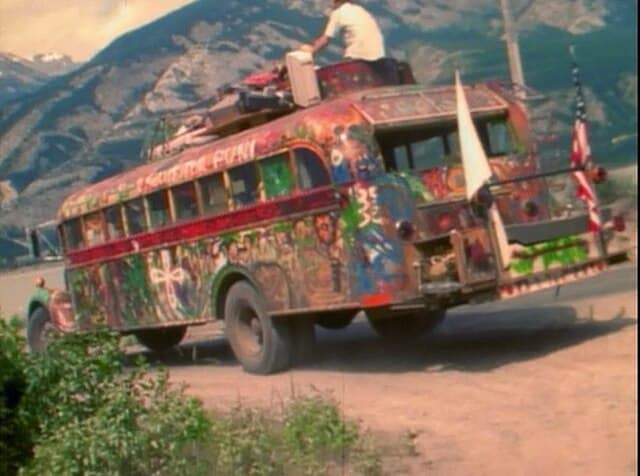
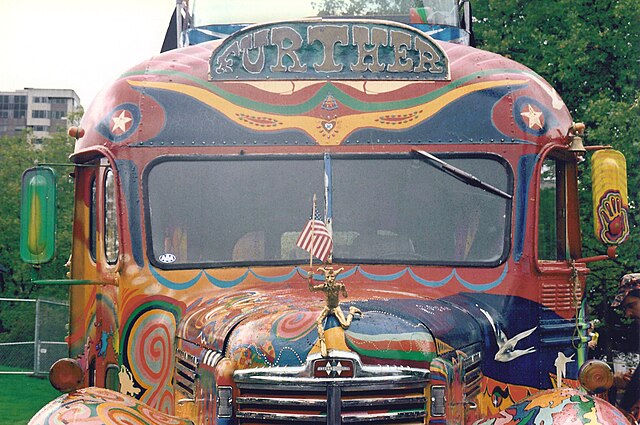
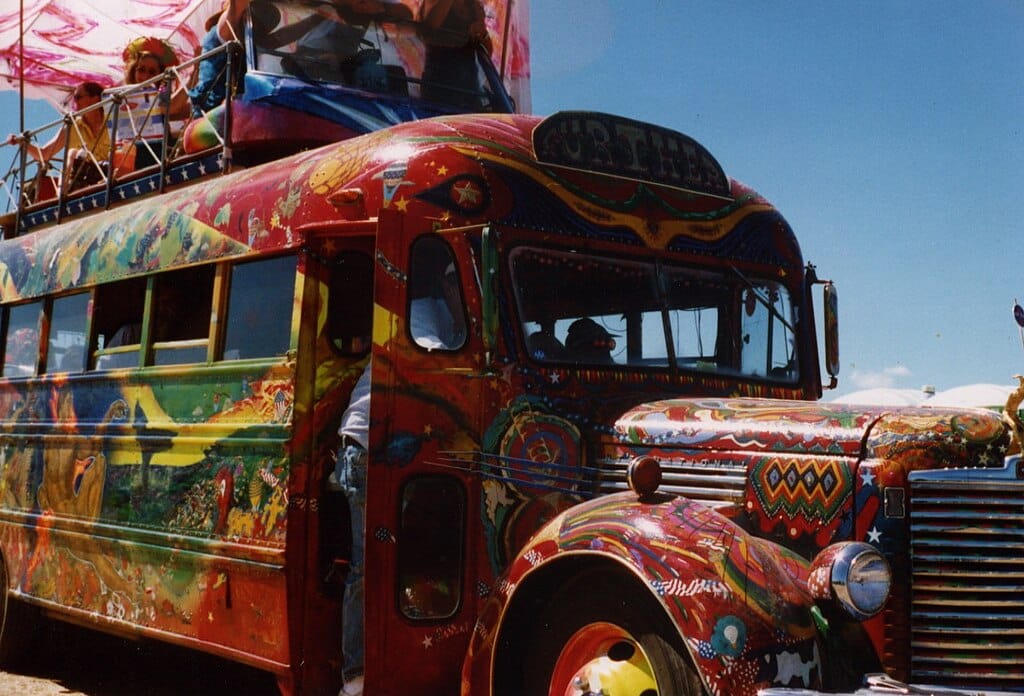
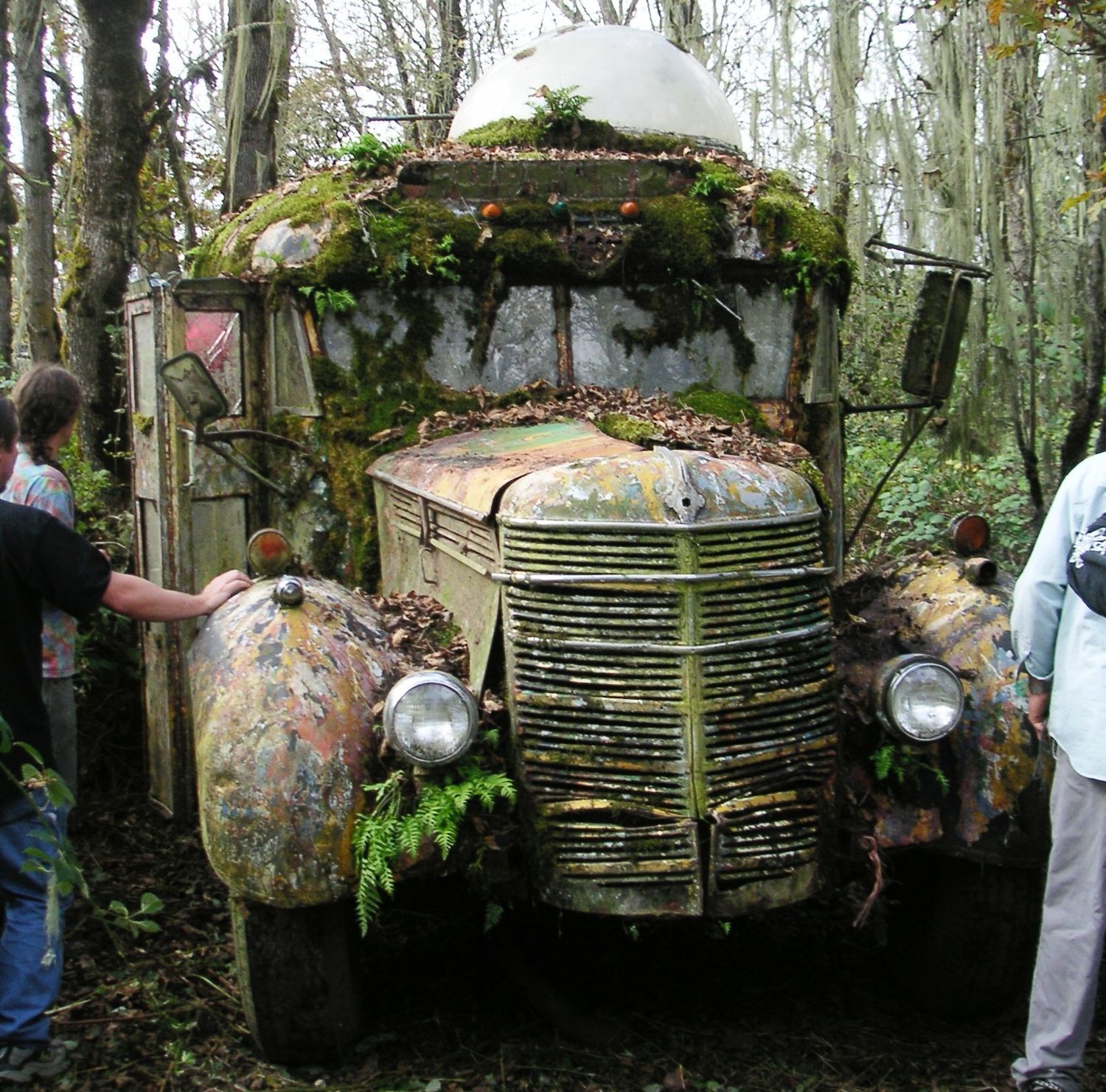
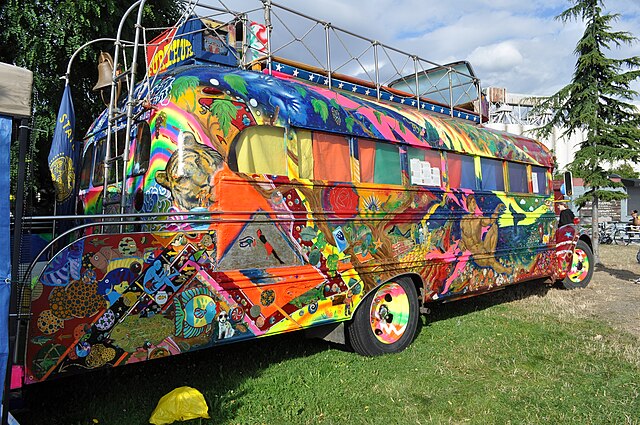
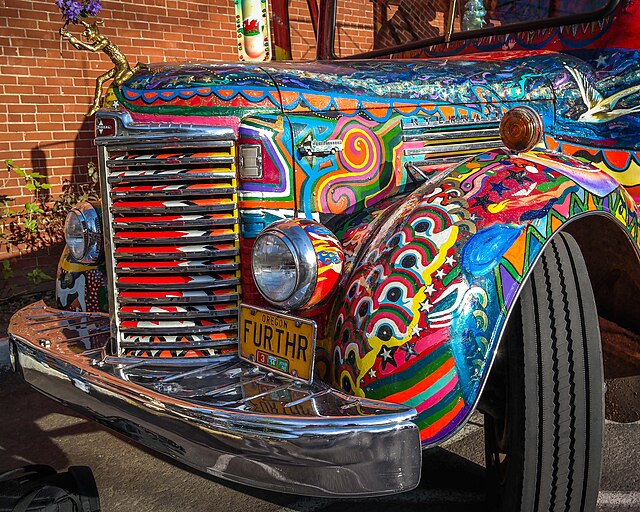
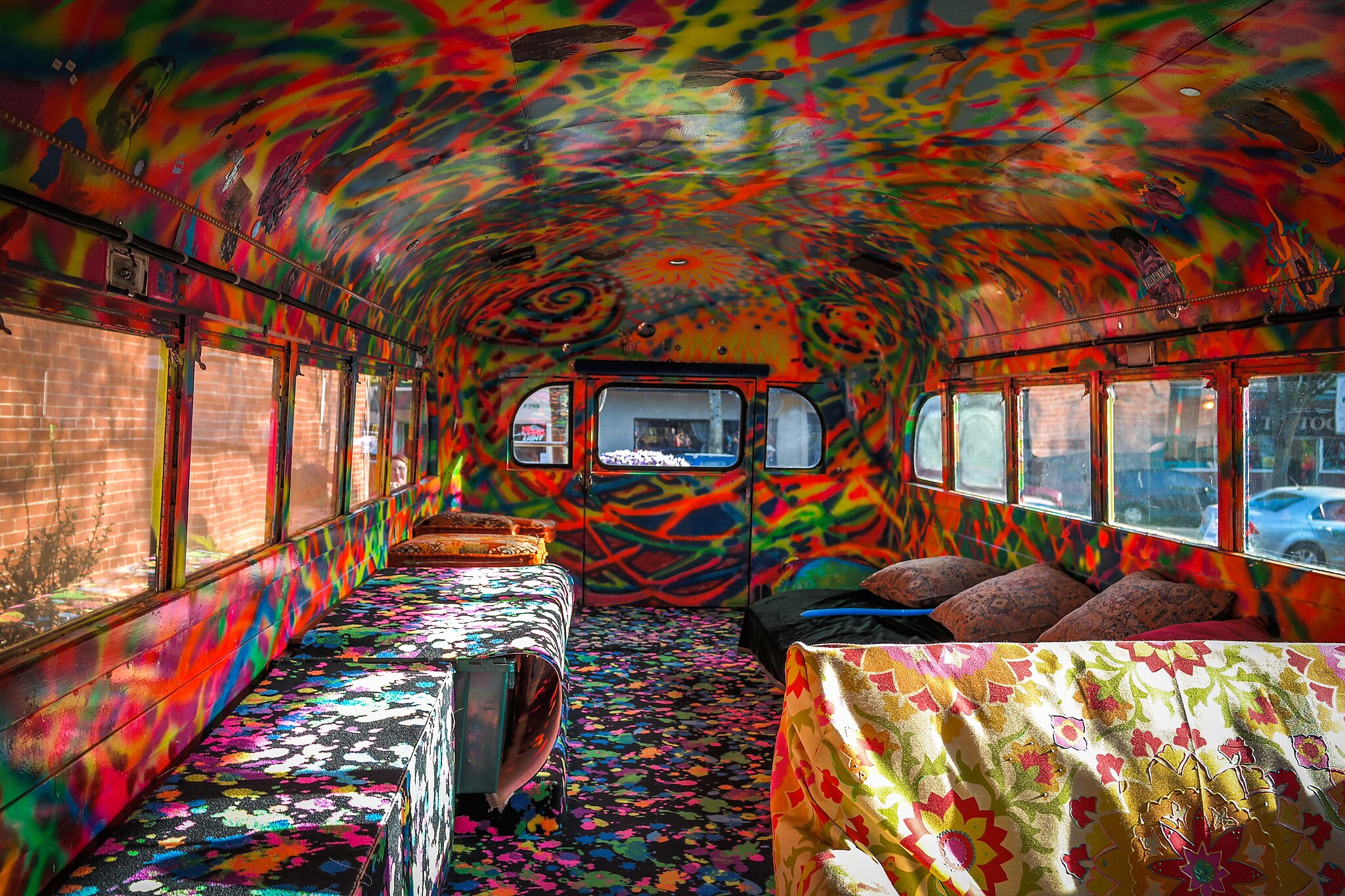
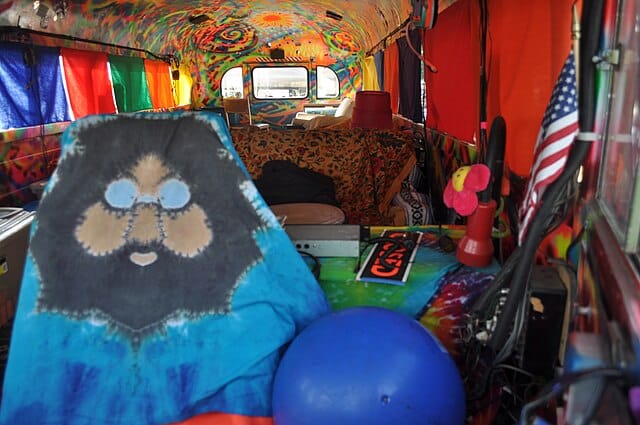
In October 2005, a dedicated group of about 30 original Pranksters, family members, and fans rescued the bus, cutting away the overgrowth and towing it to covered storage to halt further damage. Since then, the Furthur Down the Road Foundation, a nonprofit established in 2008, has led ongoing efforts to raise funds for a full restoration to its 1964 glory, involving expert mechanics and artists. Despite periodic fundraisers and involvement from Kesey’s son Zane, the project has faced financial challenges, and as of recent years, the bus now remains a rusted shell in protected storage, awaiting sufficient resources to complete the work.

The Legacy: From the Bus to the “Wall of Sound”
What did we actually get from this marriage of madness? It wasn’t just a few good stories and some stained tie-dyes. The Prankster/Dead alliance built the foundation of modern stoner culture.
The Sound System: The Pranksters’ obsession with tech and “the mix” eventually evolved into the Dead’s legendary Wall of Sound. The largest concert PA system ever built.
The Community: The “Deadhead” phenomenon is a direct descendant of the Prankster tribe, a traveling circus of seekers looking for a truth that can’t be found in a 9-to-5.
The Vibe: That specific brand of American mysticism that’s part cowboy, part cosmonaut that defines the stoner aesthetic to this day.
Part II: A Sound Engineer’s Pilgrimage
The Tapers’ Section
As a sound engineer, I didn’t just gravitate toward the Dead for the vibe; I was drawn to their Open Source philosophy. Long before the internet made “sharing” a buzzword, the Dead were letting us plug into their universe.
My journey began in 1989 at Alpine Valley, Wisconsin, followed by a transition to the concrete canyons of Soldier Field in Chicago in ’92. I was one of the many “pilgrims” who hauled gear to the center of the field.
Our setup was a ritual: two microphones, criss-crossed and duct-taped to the top of a tall, telescopic pole to capture that perfect stereo image. In that circle of recording gear, we weren’t just fans, we were archivists of the infinite.


The “Miracle” at the Gate
If you know anything about the Dead scene, you know that “scalping” was a dirty word. The community looked out for its own.
I remember one year, I ended up with eight tickets, but four people in our group bailed at the last minute.
As we approached the gates, we saw them: the road-worn travelers who followed the tour across the country, smelling of patchouli and wearing the dust of a dozen states on their tie-dyes. They stood with a single finger in the air, the universal signal for: “I need a miracle.”
I walked up to one kid and handed him the four extra tickets. The look on his face was pure shock followed by an explosion of ecstasy. He stood there with his hands folded in a bow, repeating “Thank you, thank you!” over and over. In that moment, the name “Grateful” made perfect sense. I walked into the show feeling lighter than I ever had before.
Further North: The Oregon Connection
Following the music, I eventually moved to Oregon, catching the band at Autzen Stadium in Eugene and the legendary Shoreline Amphitheatre, aka “The House that Bill Graham built” specifically for the Dead.
In Eugene, the ghost of the Pranksters became flesh and blood for me.
At one show, a friend and I were invited back to “The Farm” outside of town, near Veneta, Oregon. We pitched our tent by a massive bonfire and spent the night lost in a drum circle with singing and acoustic guitars. It wasn’t just a party; it was a continuation of the “Now” that Kesey had started decades prior.


The Long Strange Trip Ends: The Lighthouse
By 1995, I had seen so many shows that I did the unthinkable: I turned down a ticket. I had planned a trip to the Oregon Coast for August, thinking there would always be “one more Saturday night.”
I spent the day at the beach and eventually stopped at The Lighthouse, a favorite brewpub in Lincoln City. As I walked in, I saw these words scrawled on the chalkboard: “We miss you, Jerry.”
Since my name is also Jerry, the sight of it hit me like a physical blow. Then reality set in. Jerry Garcia was gone. My soul sank to my feet. That concert I skipped was his last, and the chalkboard wasn’t for me, It was for the man who had spent thirty years teaching us how to listen to the light.
The Legacy of the Long, Strange Trip
The Pranksters eventually went back to the farm, and the Dead became global icons, but that spirit remains. Whether you’re standing in a field in Wisconsin with a telescopic mic, handing a “miracle” to a stranger at the gate, or sitting in an Oregon brewpub, the bus is still rolling.


Great story. Very informative!